
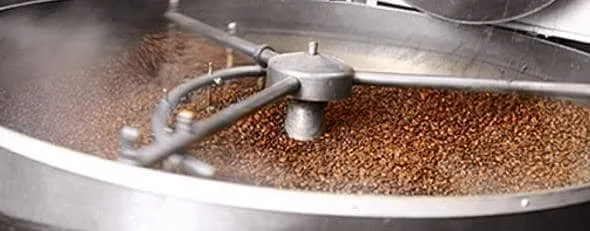
Whether we use the term roasting or roasting refers, in either case, to the process of roasting coffee beans at a high temperature so that they are dehydrated, oxidized and, in some cases, charred.
In other words, coffee roasting is the stage of production that delivers the shape and color of the beans we are used to. Let's see, specifically, how it works.
What are the stages of coffee production?
The process that brings our espresso from the plantation to the cup is long and complex. It starts with harvesting, which can generally follow two different methods: picking and stripping. In the first case, the now ripe berries are selected and picked exclusively by hand, while in the second case, a branch of the plant is grasped and the berries are ripped off from it in a single gesture, with the risk of also uprooting leaves and twigs.
Next, the fruit is separated from the seed. The resulting kernels are, at this point, washed and spread out in the open air to dry naturally, sometimes a brushing step is also added before the kernels are divided into groups based on size and degree of ripeness.
The next step is roasting the coffee, which we will see in detail in the next section. This is followed by bagging, analyzing and grinding the coffee: processes that vary greatly depending on the type of product to be obtained and the rules that each company may decide to choose.
Not all coffees, in fact, are ground, but all are definitely packaged to be sold and distributed to coffee bars, cafeterias, supermarkets, and simple enthusiasts. At this stage, it is crucial to pay attention. In fact, flavorings are volatile molecules that, therefore, risk dispersing very easily if the beans, even ground, are not sealed promptly. Once the package is closed, there is still one last, twofold step missing: resting and tasting, the last real quality control to ensure perfect coffee for the final consumer.
Coffee roasting: from bean to aroma
Coffee roasting is consists of introducing the coffee beans into a specific machine that brings them to a very high temperature in a rather short time: Temperature and timing depend, in general, on the type of coffee to be obtained.
"Fluidized bed" or "rotary drum".
There are, in particular, two distinct roasting methods. The first, also known as "fluidized bed," involves the beans being invested by a jet of hot air, at a temperature usually between 300°C and 400°C for a few minutes. The beans remain, then, briefly in suspension in the roasting chamber. The result is a coffee roasted mostly on the outside.
The second method, on the other hand, called "rotating drum" involves the use of a metal drum that continuously turns the beans. Inside it are augers or fins that help move the product and even out the entire roasting process. In this case, there is also a gas burner that keeps the air hot for as long as it takes to complete the process, which is usually between 10 and 20 minutes.
The "rotary drum" method is often preferred because it ensures a more even roasting of coffee from which a more pleasant aroma also results.
Changes for coffee during roasting
During roasting, therefore, the coffee bean is exposed to a high temperature this happens for a purpose. In fact, through the progressive transmission of heat more than 600 different chemical reactions are to be generated in the coffee bean. As early as 160°C, for example, the first ones that cause an interaction between proteins and sugars are triggered, activating the first aromas.
When the process is complete, there will be some modifications:
- 15 to 20 percent weight loss of coffee, brought about by the evaporation of water and other volatile substances.
- Increase in volume compared to the raw product.
- Formation of a blackish-brown coloration due to the carbonization of cellulose and caramelization of sugars.
Appearance on the surface of the beans of a brownish oil, i.e., caffeone, which is the factor that determines the aroma of coffee. - Slight loss of caffeine.
How the taste of roasted coffee changes
The process of roasting coffee also has an effect on taste. In fact, it is generally a more bitter type of beverage and the roasted bean is more crumbly, perfect for pulverization and grinding.
The particle size of the powder depends, of course, on how it will actually be used. It changes, in fact, depending on whether the final use is in a mocha, for a professional coffee machine, or for a home machine.
For Turkish Coffee, moreover, the powder must be very fine in order to settle to the bottom of the cup, while for Neapolitan Moka it must be coarser since there is less pressure in the tools used to prepare the coffee.
Coffee roasting and health: what relationship?
Differences in roasting also depend on tradition: in fact, "light" roasting is preferred in Anglo-Saxon countries, while "dark" roasting still prevails in Mediterranean countries. This distinction is not only chromatic, but also chemical.
In fact, dark roasting reduces the concentration of acrylamide in coffee by about 50 percent; this is a substance considered toxic that increases the risk of cancer. At the same time, it increases the presence of melanoidins, which, on the other hand, are responsible for the smell of coffee, as well as that of freshly baked hot bread, and are absorbed as fiber by the intestines.
Some scientific studies, moreover, have shown that this type of roasting allows reducing acid secretion in the stomach. To understand this, the acidity level of a group of volunteers divided, in turn, into three groups was measured: the first was given dark-roasted coffee, the second light-roasted, the third nothing, and the entire cohort of participants was given bicarbonate, after coffee, to cause a rise in pH.
The researchers observed, therefore, that in subjects in the first group, stomach acidity is significantly inhibited and gastric secretion is slowed by 20 percent compared to the third group, while in participants in the second group, the arrival of acid secretion is sped up by 30 percent.
This is good news, especially for those suffering from acid reflux or related problems who may, as a result, choose more intense coffees. Useful information that becomes even more so if we actually understood how coffee roasting works. Did you know the process?

 English
 Italian
  German
  Spanish